Archie, our 40-year-old Barred Owl, has spent a good portion of this winter living indoors due to the extremely cold temperatures. We recently were able to put him back into the Raptor Center with the milder weather. He shares a mew (a sort of stable for birds of prey) with another Barred Owl named Beaker. While I was working in the Raptor Center earlier this week I heard quite a bit of hooting coming from their mew, and found that Archie was trying to feed his mice to Beaker. I just had to capture it with my camera, though Beaker seems to be rather unimpressed by the gesture.
Michelle Leighty
Perkins Wildlife Center Manager
Saturday, March 1, 2014
Sunday, February 9, 2014
Meet Midas!
The Wildlife department had an exciting start to the new year with the arrival of its Golden Eagle last month!
We acquired the bird from the Veterinary Teaching Hospital at Washington State University. She came to us with impaired vision in her right eye and an injury to her right wing, both of which made her unable to be released into the wild. She is currently settled in our Raptor Center and staff are working hard on getting her trained for program use. Her training is going well and she is already reliably stepping up to a glove and allowing herself to be walked and weighed. Once we have completed her box training we plan to bring her to classes and programs, where she will act as an ambassador for her species.
Golden Eagles are not common in Ohio, but they can occasionally be spotted in the winter, especially in the wide open spaces of the eastern and southeastern parts of the state. I have seen wild Golden Eagles nearly ever winter soaring over the reclaimed mine lands of The Wilds in Muskingum County. They are one of the largest and fastest birds in North America and favor open country habitats, feeding on animals of varying sizes such as rabbits and deer, and even foxes and bobcats! We are happy our new eagle has a calm and mild disposition and allows us to work with her without any aggression.
The dark brown plumage of the adult Golden Eagle is highlighted with a golden sheen on the head and neck. This gives the bird a regal appearance, which is one reason we named ours Midas. Watch for Midas at our live animal programs this spring! She is quite a sight to behold!
Michelle Leighty
Perkins Wildlife Center Manager
We acquired the bird from the Veterinary Teaching Hospital at Washington State University. She came to us with impaired vision in her right eye and an injury to her right wing, both of which made her unable to be released into the wild. She is currently settled in our Raptor Center and staff are working hard on getting her trained for program use. Her training is going well and she is already reliably stepping up to a glove and allowing herself to be walked and weighed. Once we have completed her box training we plan to bring her to classes and programs, where she will act as an ambassador for her species.
Golden Eagles are not common in Ohio, but they can occasionally be spotted in the winter, especially in the wide open spaces of the eastern and southeastern parts of the state. I have seen wild Golden Eagles nearly ever winter soaring over the reclaimed mine lands of The Wilds in Muskingum County. They are one of the largest and fastest birds in North America and favor open country habitats, feeding on animals of varying sizes such as rabbits and deer, and even foxes and bobcats! We are happy our new eagle has a calm and mild disposition and allows us to work with her without any aggression.
The dark brown plumage of the adult Golden Eagle is highlighted with a golden sheen on the head and neck. This gives the bird a regal appearance, which is one reason we named ours Midas. Watch for Midas at our live animal programs this spring! She is quite a sight to behold!
Michelle Leighty
Perkins Wildlife Center Manager
Sunday, December 1, 2013
Ice Age!
Even some of our owls visited the free photo green screen at Ice Age!
Katie Overholser holds Tamarack the Great Horned Owl, Michelle Leighty holds Radar the Barn Owl, and Heather Bowman holds Beaker the Barred Owl.
In addition to the photo opportunities, Ice Age visitors can watch two live animal programs, view ice sculpting and dog sledding demonstrations, make arts and crafts, and participate in a scavenger hunt. Ice Age takes place on weekends through January 05. More information can be found here:
http://www.cmnh.org/site/ClassesandPrograms/SpecialEvents/IceAge.aspx
Katie Overholser holds Tamarack the Great Horned Owl, Michelle Leighty holds Radar the Barn Owl, and Heather Bowman holds Beaker the Barred Owl.
In addition to the photo opportunities, Ice Age visitors can watch two live animal programs, view ice sculpting and dog sledding demonstrations, make arts and crafts, and participate in a scavenger hunt. Ice Age takes place on weekends through January 05. More information can be found here:
http://www.cmnh.org/site/ClassesandPrograms/SpecialEvents/IceAge.aspx
Monday, October 21, 2013
A Very Hoppy Welcome to Our New Snowshoe Hares!
Last week we welcomed three new snowshoe hares to the Perkins Wildlife Center. They were born in captivity just two months ago and were in need of a place to live. Many times when a wild animal is raised in captivity it becomes too friendly or too used to people. Since these animals were raised by humans and never learned how to be “wild” hares they were not able to be released. The museum is now their permanent home and we are very happy to have them. Snowshoe hares are interesting animals that allow us to educate our visitors on what most think are “just rabbits.” Although they belong to the same family, snowshoe hares are quite different. For example, rabbits are altricial, born helpless, hairless and blind. Hares are what are called precocial and they are born ready to go, with both vision and fur. Soon after a hare is born it is ready to live on its own. Both are herbivores but rabbits tend to eat softer plant matter such as grasses and stems, whereas hares prefer to eater harder plant matter like bark, twigs and buds.
Snowshoe hares are one of Ohio’s endangered mammal species and their decreasing populations are becoming even more of a concern with climate change. The fur of a snowshoe hare changes from brown in the spring to white in the winter. This camouflage, along with their “snowshoe” like feet to help them stay above the snow when they hop, is essential in keeping them safe from predators. This change in fur color occurs not based on temperature changes but on the amount of light in the day. As the days get shorter in the winter and there is less daylight, it triggers a hare's coat to start changing white. A snowshoe hare's coat will change color seasonally regardless of what the weather is doing. If snowfall starts later and/or melts earlier in the season there are fewer places for the hares to hide. A white hare against a green and brown background makes it easy prey. The hare might think that it is camouflaged, but it is not, making it much more vulnerable to predators. Although snowshoe hares are rarely seen in Ohio they are very common throughout the northern forests of North America and also in Canada.
Hurry to the museum and visit the hares as their coats begin to change to winter white. You can learn lots more about snowshoe hares and other native Ohio wildlife at the Perkins Wildlife Center and Woods Garden!
Melissa Terwilliger
CMNH Wildlife Specialist
Saturday, August 10, 2013
Kirtlandia Research Intern 2013
Cara Anderson spent the summer in the Wildlife Resources department researching the intelligence and problem solving capabilities of American Crows, using our resident crows Rook and Roxy as her subjects. On August 10 she presented her findings to the Kirtlandia Society and also participated in a poster session.
The Kirtlandia Research Interns spend 8 weeks during the summer conducting research projects at the museum, working with curators and other staff. To learn more about the program and how to apply visit this link:
http://www.cmnh.org/site/AboutUs/CareerOpportunities/AdoptAStudent.aspx
Thanks for all of your hard work, Cara!
The Kirtlandia Research Interns spend 8 weeks during the summer conducting research projects at the museum, working with curators and other staff. To learn more about the program and how to apply visit this link:
http://www.cmnh.org/site/AboutUs/CareerOpportunities/AdoptAStudent.aspx
Thanks for all of your hard work, Cara!
Friday, July 26, 2013
More than Just a “Saber-toothed Sausage”
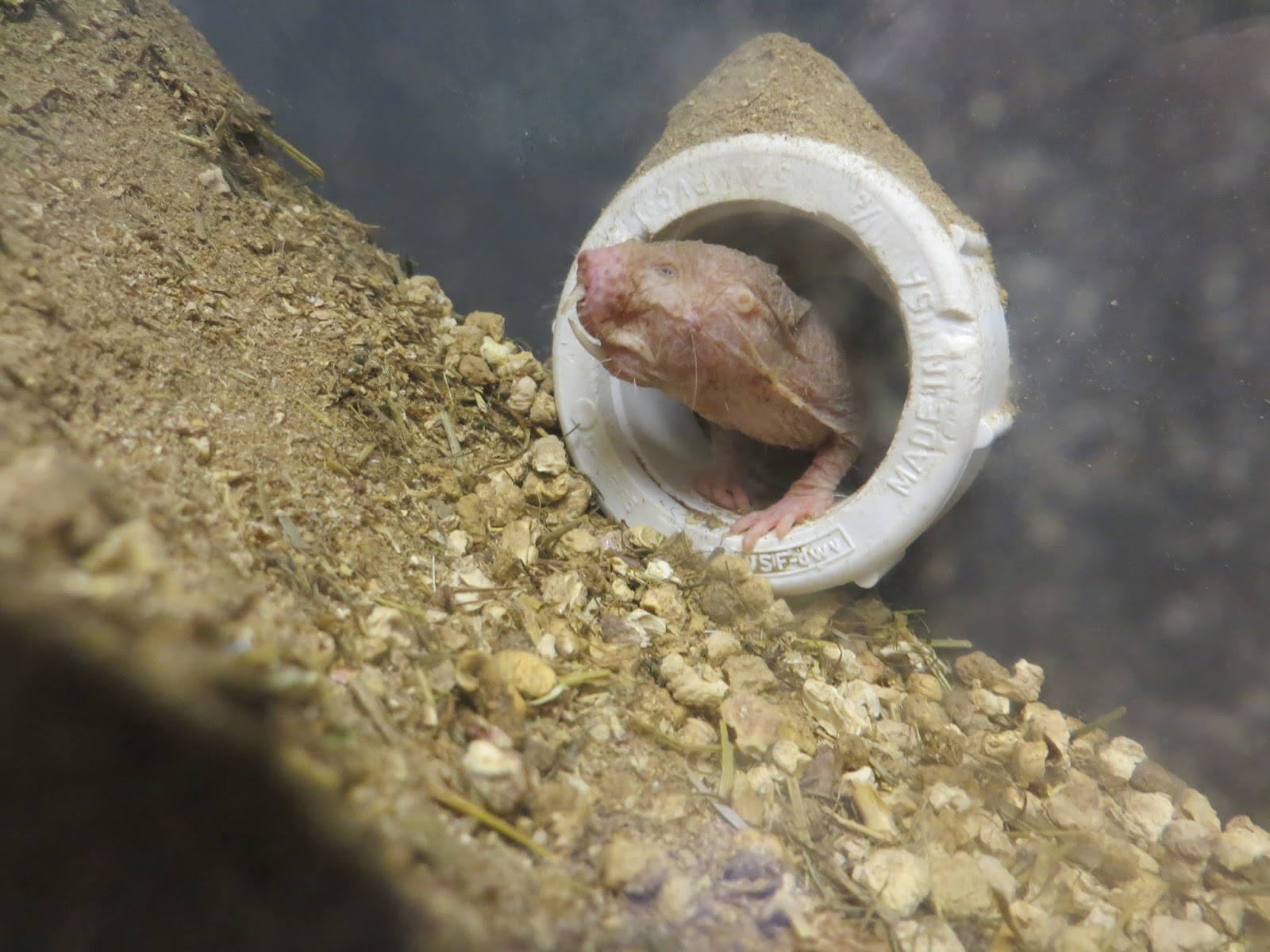
Eww!...Cool!...Wow! Just some of the things you might say when you see the museum's naked mole rat collection. Our naked mole rat colony arrived at the museum in 2010 to be displayed with the traveling exhibit “Extreme Mammals.” Right now they are housed behind the scenes but will soon be back on exhibit within the museum.
Although they look naked, these mole rats actually have tiny hairs all over their bodies that act like whiskers and help them get around. They don’t need lots of thick fur because they spend their lives entirely underground in their native region of East Africa. They build underground communities, much like that of some insects, and are one of two mammal species that are eusocial. This means that each mole rat colony has one designated “queen” that “rules the roost” so to speak. She will breed with a few males of the colony while the non-breeding individuals of the colony help to take care of the young and provide for (workers) and protect (soldiers) the rest of the group. Our mole rat colony here at the Cleveland Museum of Natural History currently has 37 individuals. The queen can have young between four and five times a year and have up to 27 young at a time. With ample space and food resources, a colony can contain up to 300 individuals !!!
Naked mole rats use their sharp incisors and flexible bodies to dig their extensive tunnel systems, find food (roots and tubers) and fend off predators (their main predator being snakes that enter their burrows). They work together to survive and count on each other to keep warm when the temperature drops. The mole rats do not have the ability to regulate their own body temperature and therefore need to make their homes in underground areas where the temperature remains mostly constant. But what about the low oxygen supply underground? No problem for naked mole rats. These little guys do need oxygen to survive but have highly adapted respiratory and cardiovascular systems that allow them to survive in these low oxygen environments. How amazing! And I haven’t even touched on one of the most amazing facts about these little rodents! They are immune to cancer and can live up to 30 years! This is far longer than other rodents. Scientists from around the world are highly intrigued and are doing extensive research to determine what it is that keeps naked mole rats cancer free. Many discoveries have been made as experiments continue and researchers hope to one day use these findings to develop a cure for human cancer.
Be sure to look for our naked mole rat collection within upcoming exhibits!
Melissa Terwilliger
Wildlife Specialist
Although they look naked, these mole rats actually have tiny hairs all over their bodies that act like whiskers and help them get around. They don’t need lots of thick fur because they spend their lives entirely underground in their native region of East Africa. They build underground communities, much like that of some insects, and are one of two mammal species that are eusocial. This means that each mole rat colony has one designated “queen” that “rules the roost” so to speak. She will breed with a few males of the colony while the non-breeding individuals of the colony help to take care of the young and provide for (workers) and protect (soldiers) the rest of the group. Our mole rat colony here at the Cleveland Museum of Natural History currently has 37 individuals. The queen can have young between four and five times a year and have up to 27 young at a time. With ample space and food resources, a colony can contain up to 300 individuals !!!
Naked mole rats use their sharp incisors and flexible bodies to dig their extensive tunnel systems, find food (roots and tubers) and fend off predators (their main predator being snakes that enter their burrows). They work together to survive and count on each other to keep warm when the temperature drops. The mole rats do not have the ability to regulate their own body temperature and therefore need to make their homes in underground areas where the temperature remains mostly constant. But what about the low oxygen supply underground? No problem for naked mole rats. These little guys do need oxygen to survive but have highly adapted respiratory and cardiovascular systems that allow them to survive in these low oxygen environments. How amazing! And I haven’t even touched on one of the most amazing facts about these little rodents! They are immune to cancer and can live up to 30 years! This is far longer than other rodents. Scientists from around the world are highly intrigued and are doing extensive research to determine what it is that keeps naked mole rats cancer free. Many discoveries have been made as experiments continue and researchers hope to one day use these findings to develop a cure for human cancer.
Be sure to look for our naked mole rat collection within upcoming exhibits!
Melissa Terwilliger
Wildlife Specialist
Tuesday, July 2, 2013
Lancelot
All hail Sir Lancelot! Welcome to the newest member of the Perkins Wildlife Family!
On May 10th, the Perkins Wildlife Center welcomed its newest member: a 10-day-old porcupine who has since been dubbed Lancelot! He came to us from Pennsylvania and at the time weighed only 400 grams and was still drinking formula. Our wildlife specialists took turns taking him home every night so that we could continue his around-the-clock feedings since just like a human baby he needed to eat every 3 to 4 hours. He is now a healthy, growing 2-month-old who weighs about 1100 grams and eats a steady diet of fruits, vegetables, and rodent blocks. Once full grown, at about a year of age, he will weigh anywhere between 30 and 40 pounds! He has settled into life here in the Perkins Wildlife Center quite nicely and we are very happy to have him!
Why a porcupine at the Cleveland Museum of Natural History you may ask? As most know, we care for a collection of over 80 native Ohio animals, but many don’t know that porcupines were also once found in Ohio. They had a vast range over much of the northeastern United States, but were extirpated from Ohio due to deforestation in the 1800's. They have remained common in the expansive forests of nearby Pennsylvania. It is theorized that there might be porcupines in Ashtabula and Trumbull counties. We are very excited to welcome Lancelot to our collection as an animal ambassador who will be able to go to educational programs and meet and greet the public to help educate them about porcupines. For example, many people are under the misconception that porcupines can shoot out their quills as a means of defense against predators. This is not exactly how a porcupine defends itself. They do have quills that become barbs when stuck in a predator, but they cannot shoot them out. What a porcupine will do, however, is smack a predator with his tail where the majority of his quills are and thus the predator will end up with the quills embedded in his body. And a porcupine doesn't only have quills on his tail. They actually have them all over their body except on their stomachs.
To learn more about these fascinating creatures (They can swim! Their hollow quills make them very buoyant!) come visit us for one of our live animal shows and you may just get lucky enough to meet our newest member! Our shows are at 1:00 pm and 3:00 pm on Saturdays and Sundays and at 1:30 pm every week day through Labor Day.
Nikki McClellan
Wildlife Specialist/Enrichment Coordinator
On May 10th, the Perkins Wildlife Center welcomed its newest member: a 10-day-old porcupine who has since been dubbed Lancelot! He came to us from Pennsylvania and at the time weighed only 400 grams and was still drinking formula. Our wildlife specialists took turns taking him home every night so that we could continue his around-the-clock feedings since just like a human baby he needed to eat every 3 to 4 hours. He is now a healthy, growing 2-month-old who weighs about 1100 grams and eats a steady diet of fruits, vegetables, and rodent blocks. Once full grown, at about a year of age, he will weigh anywhere between 30 and 40 pounds! He has settled into life here in the Perkins Wildlife Center quite nicely and we are very happy to have him!
Why a porcupine at the Cleveland Museum of Natural History you may ask? As most know, we care for a collection of over 80 native Ohio animals, but many don’t know that porcupines were also once found in Ohio. They had a vast range over much of the northeastern United States, but were extirpated from Ohio due to deforestation in the 1800's. They have remained common in the expansive forests of nearby Pennsylvania. It is theorized that there might be porcupines in Ashtabula and Trumbull counties. We are very excited to welcome Lancelot to our collection as an animal ambassador who will be able to go to educational programs and meet and greet the public to help educate them about porcupines. For example, many people are under the misconception that porcupines can shoot out their quills as a means of defense against predators. This is not exactly how a porcupine defends itself. They do have quills that become barbs when stuck in a predator, but they cannot shoot them out. What a porcupine will do, however, is smack a predator with his tail where the majority of his quills are and thus the predator will end up with the quills embedded in his body. And a porcupine doesn't only have quills on his tail. They actually have them all over their body except on their stomachs.
To learn more about these fascinating creatures (They can swim! Their hollow quills make them very buoyant!) come visit us for one of our live animal shows and you may just get lucky enough to meet our newest member! Our shows are at 1:00 pm and 3:00 pm on Saturdays and Sundays and at 1:30 pm every week day through Labor Day.
Nikki McClellan
Wildlife Specialist/Enrichment Coordinator
Wednesday, June 19, 2013
Painting Bobcat!
Here at the museum the wildlife staff does a variety of different training and enrichment activities to keep our animals active and mentally stimulated. Enrichment can be an object, scent, or new environment that stimulates and excites the animal. In the past we have done paintings with our snakes and groundhog, which stimulates their senses of touch and sight. Recently we found out we have another artist in our wildlife department, an 11-year-old bobcat named Bob!
We incorporated training that Bob already knew in order for him to create the painting. We train many of our animals behaviors that make it easier and safer for the keepers to interact with them and also that keep them mentally and physically fit. "Target" is a trained behavior that many of our animals know. It involves an animal touching a ball that is on the end of a stick with their snout or paws. This allows us to direct where we want our animals to go in the exhibit. When we hold out the target pole and give the command, the animal comes over and, in Bob’s case, places both front paws on the target ball. Since Bob had never seen or touched canvas or paint before, it was a great enrichment for him and reinforced his training in a completely different way than had been done before.
Bob targeting:
Targeting Bob to the canvas and paint:
Heather Bowman
CMNH Wildlife Specialist
Saturday, June 8, 2013
Parade the Circle
The museum's animal ambassadors had quite a presence at this year's Parade the Circle! Here is a snap of Wildlife Resources volunteer Peter Pesch and Beaker the Barred Owl near the parade route in front of CMNH.
photo by Michelle Leighty
Tuesday, May 28, 2013
Look Who's Here!
More on our baby North American porcupine Lancelot coming soon!
photo by Michelle Leighty, Perkins Wildlife Center Manager
Thursday, May 23, 2013
Terminal Tower Peregrine Falcons 2013
Yesterday afternoon some of the Wildlife Resources staff and interns went to visit the Peregrine Falcons on the Terminal Tower. The current pair is S/W (the female) and Boomer (the male). This is S/W's twelfth year at the nest site and Boomer's third.
Two chicks hatched at the nest this year during the month of April. They were banded on May 14 and were both determined to be female. They were named "Ginger" and "Tess." They seem to be doing well and will soon be walking along and exploring the ledges of the Terminal Tower.
Click images to enlarge.
S/W:
One of the chicks:
The other chick:
Booomer keeps watch from above:
Close-up of S/W:
Photos by Michelle Leighty, Perkins Wildlife Center Manager
Keep track of the falcons online with the CMNH FalconCam here:
http://www.falconcam-cmnh.org/
Two chicks hatched at the nest this year during the month of April. They were banded on May 14 and were both determined to be female. They were named "Ginger" and "Tess." They seem to be doing well and will soon be walking along and exploring the ledges of the Terminal Tower.
Click images to enlarge.
S/W:
One of the chicks:
The other chick:
Booomer keeps watch from above:
Close-up of S/W:
Photos by Michelle Leighty, Perkins Wildlife Center Manager
Keep track of the falcons online with the CMNH FalconCam here:
http://www.falconcam-cmnh.org/
Monday, March 25, 2013
slow motion footage of three of our owls
Check out this superb video featuring Omega the Eastern Screech Owl, Radar the Barn Owl, and Tamarack the Great Horned Owl!
Produced by Christian Daugstrup (4 Point OH Productions), Nick Anderson (Silver Lightning Media), and Christopher George
Music: Chris Zabriskie - "John Stockton Slow Drag"
Filmed on the Sony NEX-FS700 at 240 frames per second with the Canon EF 24-105mm f/4 L IS lens
Behind-the-scenes shots of the filming process (courtesy of the production staff) show Michelle Leighty holding Tamarack and Omega for the camera:
Produced by Christian Daugstrup (4 Point OH Productions), Nick Anderson (Silver Lightning Media), and Christopher George
Music: Chris Zabriskie - "John Stockton Slow Drag"
Filmed on the Sony NEX-FS700 at 240 frames per second with the Canon EF 24-105mm f/4 L IS lens
Behind-the-scenes shots of the filming process (courtesy of the production staff) show Michelle Leighty holding Tamarack and Omega for the camera:
Tuesday, March 5, 2013
Sam!
Sam Keum is a high school student at Hathaway Brown and has been interning for us in the wildlife department at CMNH for over a year. Earlier today she presented a poster of her experiences at the Science Research & Engineering Program reception, where she talked to hundreds of guests about working with the animals at the museum. Thanks for all of your time and hard work, Sam!
Monday, March 4, 2013
new falcon Endeavour
The Wildlife Resources department is pleased to announce that it recently added a Peregrine Falcon named "Endeavour" to its collection!
(photo by Traci Lambert - click to enlarge)
Endeavour arrived just a few weeks ago from a wildlife rehabilitation center in the state of Washington, where she was deemed to be non-releasable due to visual impairment. She is not able to see well enough to hunt on her own. Her eyes are structurally sound so the problem is with her nervous system, most likely the result of a trauma. We are currently assuming that Endeavour is a female based on her size compared to our known male. Peregrine Falcon females are usually considerably larger and stronger than the males. We plan to do a blood test in the spring to confirm.
Endeavour has a dark chest right now since she is a juvenile. She will get her adult plumage at around one year of age. Peregrines can live up to 15-17 years in the wild and even longer in captivity, so we hope to have her for a very long time.
Peregrine Falcons are most famous for the speeds they reach during a hunt for prey. When they spot another bird, they will go into a stoop or dive reaching speeds of up to 200 mph. Even their normal flight is faster than most other birds at 62 mph. They are very adaptable and can be found on all continents except Antarctica. In fact their scientific name, Falco peregrinus, means "wandering falcon." In the wild they nest on rocky cliffs but have also adapted to using tall buildings and bridges in cities.
The peregrine population was nearly wiped out east of the Mississippi river in 1968 due to the use of a chemical called DDT that weakened the shells of their eggs. In 1972 the use of DDT was restricted. In 1989 a program was started to reintroduce the falcons to Ohio. As a result they are now considered "threatened". As of last year, there were 36 known pairs at nesting sites in Ohio. 23 of those pairs produced a total of 59 juveniles.
If you would like to see a Peregrine Falcon up close please join us in the Perkins Wildlife Center where "Lou" is on display. Endeavour is going to be an education bird at CMNH. She is already quite good at stepping up on the glove so you may meet her taking a walk with one of our wildlife specialists. Once she is trained to go into a travel carrier she will be used in the educational programs.
Traci Lambert
CMNH Wildlife Specialist
(photo by Traci Lambert - click to enlarge)
Endeavour arrived just a few weeks ago from a wildlife rehabilitation center in the state of Washington, where she was deemed to be non-releasable due to visual impairment. She is not able to see well enough to hunt on her own. Her eyes are structurally sound so the problem is with her nervous system, most likely the result of a trauma. We are currently assuming that Endeavour is a female based on her size compared to our known male. Peregrine Falcon females are usually considerably larger and stronger than the males. We plan to do a blood test in the spring to confirm.
Endeavour has a dark chest right now since she is a juvenile. She will get her adult plumage at around one year of age. Peregrines can live up to 15-17 years in the wild and even longer in captivity, so we hope to have her for a very long time.
Peregrine Falcons are most famous for the speeds they reach during a hunt for prey. When they spot another bird, they will go into a stoop or dive reaching speeds of up to 200 mph. Even their normal flight is faster than most other birds at 62 mph. They are very adaptable and can be found on all continents except Antarctica. In fact their scientific name, Falco peregrinus, means "wandering falcon." In the wild they nest on rocky cliffs but have also adapted to using tall buildings and bridges in cities.
The peregrine population was nearly wiped out east of the Mississippi river in 1968 due to the use of a chemical called DDT that weakened the shells of their eggs. In 1972 the use of DDT was restricted. In 1989 a program was started to reintroduce the falcons to Ohio. As a result they are now considered "threatened". As of last year, there were 36 known pairs at nesting sites in Ohio. 23 of those pairs produced a total of 59 juveniles.
If you would like to see a Peregrine Falcon up close please join us in the Perkins Wildlife Center where "Lou" is on display. Endeavour is going to be an education bird at CMNH. She is already quite good at stepping up on the glove so you may meet her taking a walk with one of our wildlife specialists. Once she is trained to go into a travel carrier she will be used in the educational programs.
Traci Lambert
CMNH Wildlife Specialist
Friday, February 15, 2013
Training Beaker
Here at the museum we have many raptors that are gloved trained. These animals are used in shows, education programs, and often walked around the galleries for visitors to see. Not all raptors have the appropriate disposition to be gloved trained. When a facility gets a bird that is not releasable the bird is evaluated to determine whether it has the temperament to be glove trained or whether it would be better suited for display.
Most recently we have been working with Beaker, a new Barred Owl. He came from a wildlife rehabilitation center here in Ohio with a wing injury that deemed him un-releasable. Upon his arrival, he was a little nervous around all the new people and surroundings. This meant that our first step in training him for use on the glove would be spending as much time with him as we could and getting him comfortable with us being around. We spent weeks sitting in his mew with him, hoping he would soon get used to our presence.
When training an animal to do something new, a step by step training plan is written and a reward is given when the animal performs the way you want. Many animals are motivated by food. Some animals, however, are a little more complicated. Beaker did not seem to be very motivated and had no interest in taking food from us. We had to think of something that could serve as a reward when training Beaker to step up on the glove. We decided that the reward should be us leaving his mew. So, when Beaker performed as we wanted him to we would reward him by quickly leaving him alone and stepping out of his territory.
Beaker progressed quickly and became more and more comfortable with us getting close to him. We were soon able to get to the point where we could walk right up to him and the majority of the sessions have him step right up on the glove. He sits on the glove quite contentedly and seems to enjoy getting out and meeting the public. Soon he will be used as an education bird in many of the wildlife programs here at the museum.
Whenever you are training an animal there will be bumps in the road and the occasional setback but you must remain positive and never lose sight of the goal. All of your hard work and efforts will eventually be rewarded when the animal learns a new behavior.
Melissa Terwilliger
CMNH Wildife Specialist
Most recently we have been working with Beaker, a new Barred Owl. He came from a wildlife rehabilitation center here in Ohio with a wing injury that deemed him un-releasable. Upon his arrival, he was a little nervous around all the new people and surroundings. This meant that our first step in training him for use on the glove would be spending as much time with him as we could and getting him comfortable with us being around. We spent weeks sitting in his mew with him, hoping he would soon get used to our presence.
When training an animal to do something new, a step by step training plan is written and a reward is given when the animal performs the way you want. Many animals are motivated by food. Some animals, however, are a little more complicated. Beaker did not seem to be very motivated and had no interest in taking food from us. We had to think of something that could serve as a reward when training Beaker to step up on the glove. We decided that the reward should be us leaving his mew. So, when Beaker performed as we wanted him to we would reward him by quickly leaving him alone and stepping out of his territory.
Beaker progressed quickly and became more and more comfortable with us getting close to him. We were soon able to get to the point where we could walk right up to him and the majority of the sessions have him step right up on the glove. He sits on the glove quite contentedly and seems to enjoy getting out and meeting the public. Soon he will be used as an education bird in many of the wildlife programs here at the museum.
Whenever you are training an animal there will be bumps in the road and the occasional setback but you must remain positive and never lose sight of the goal. All of your hard work and efforts will eventually be rewarded when the animal learns a new behavior.
Melissa Terwilliger
CMNH Wildife Specialist
Friday, January 18, 2013
Groundhog Fun-day 2013!
Eddie the Groundhog painted his first masterpiece of 2013 earlier this week!
Painting is a good enrichment activity for our animals and also produces unique animal artwork humans can enjoy. Eddie paints by walking through non-toxic paint and then onto a blank canvas. He is rewarded throughout the process with tasty banana chips, his favorite treat.
His artwork will be raffled at our Groundhog Fun-day event on Saturday, February 2nd. Eddie will make two appearances in the museum's auditorium as well. This Groundhog Day festival will also feature crafts, activities, and live animal programs showcasing Ohio hibernators.
More information (including the schedule) can be found at this link:
http://cmnh.org/site/ClassesandPrograms/SpecialEvents/Groundhog.aspx
I look forward to spending Groundhog Day this year with a real live groundhog and hope you will come join in the fun too!
Michelle Leighty
Perkins Wildlife Center Co-Manager
Painting is a good enrichment activity for our animals and also produces unique animal artwork humans can enjoy. Eddie paints by walking through non-toxic paint and then onto a blank canvas. He is rewarded throughout the process with tasty banana chips, his favorite treat.
His artwork will be raffled at our Groundhog Fun-day event on Saturday, February 2nd. Eddie will make two appearances in the museum's auditorium as well. This Groundhog Day festival will also feature crafts, activities, and live animal programs showcasing Ohio hibernators.
More information (including the schedule) can be found at this link:
http://cmnh.org/site/ClassesandPrograms/SpecialEvents/Groundhog.aspx
I look forward to spending Groundhog Day this year with a real live groundhog and hope you will come join in the fun too!
Michelle Leighty
Perkins Wildlife Center Co-Manager
Monday, January 14, 2013
Christmas Trees for Critters!
Each year after the winter holidays the Wildlife Resources department takes donations of Christmas trees. The trees are wonderful natural enrichment items for the animals and they also dress up our exhibits a bit.
This year we received a record number of trees, so nearly every animal at the museum has had a chance to interact with one. The birds use them for perching, the opossums and snakes climb in the branches, and the bobcats and hares like to hide deep within the greenery.
Here are a few pictures I took earlier today of the raccoons enjoying one of the trees! I hid some of their vegetables for the day far inside of the evergreen so that they had to climb and forage in order to get their snack. Click the images to enlarge.
Thank you to everyone who brought us a tree and helped provide the animals with a festive and fun enrichment activity!
Michelle Leighty
Perkins Wildlife Center Co-Manager
This year we received a record number of trees, so nearly every animal at the museum has had a chance to interact with one. The birds use them for perching, the opossums and snakes climb in the branches, and the bobcats and hares like to hide deep within the greenery.
Here are a few pictures I took earlier today of the raccoons enjoying one of the trees! I hid some of their vegetables for the day far inside of the evergreen so that they had to climb and forage in order to get their snack. Click the images to enlarge.
Thank you to everyone who brought us a tree and helped provide the animals with a festive and fun enrichment activity!
Michelle Leighty
Perkins Wildlife Center Co-Manager
Tuesday, November 27, 2012
Spaulding
All,
It is with sadness that I have report to you that Spaulding, our exhibit gray fox for the past ten years, was euthanized on Monday, November 26 upon the recommendation of Dr. Lewandowski, Chief Veterinarian at the Cleveland Metroparks Zoo.
Spaulding had shown symptoms of distress on Saturday and was taken to the zoo. Chest films showed lungs and pericardial sac full of fluid and his enlarged heart barely visible. Needless to say, Spaulding was in respiratory distress. Intensive treatment with oxygen tent therapy and large amounts of diuretics brought some relief and improvement by Sunday morning enough so that Spaulding ate some medicine laced meatballs. However his condition deteriorated on Sunday night and into Monday. He wouldn't eat and thus wouldn't take his medications. He again was in distress. Dr. Lewandowski felt that if we pursued herculean efforts, perhaps Spaulding would recover and linger a few more months. But the reality of the congestive heart failure is that he would be in intense pain, stressed by constant handling to administer medications, and he would have zero quality of life. Based on his assessment, I gave the go-ahead to euthanize Spaulding and permanently ease his suffering.
I want to thank Nikki McClellan, Melissa Terwilliger and Joe Dell'Anno for quick action on Saturday, identifying the problem and getting him to the zoo. He received world class care over the past three days.
Spaulding was a scrappy little fox with a great personality. Coming from a fur farm where he was kept under horrendous conditions, he was obtained by CMNH in 2002. In the move from the Raptor Center, where he was temporarily housed, to his exhibit, his leg broke. Upon treatment he was discovered to have metabolic bone disease, a condition that would lead to a lifetime of arthritis, dislocations and dental problems. This condition was a result of the abhorrent conditions of the Grand River Fur Farm where he was kept in darkness and fed a nutrient poor diet for the first year of his life.
And yet in spite of all of that he was a great exhibit animal, very responsive to training and enrichment and very interactive with visitors, often spending time in the very front of the enclosure, curious at passers-by. For ten years he was an outstanding ambassador for the Museum, educating and entertaining our visitors, giving them insights into this little known Ohio canid and only tree climbing member of the dog family. I will always have fond memories of him joyfully rubbing his back in the otters' towels, provided as enrichment, as well as lounging from the top of the artificial tree in his exhibit.
And in the end I am appreciative that he was able to spend his life with us, rather than be housed in a crowded wire cage suspended from the ceiling of a low dark pole barn, where his only use to his master was as a source of urine.
He will be missed.
Harvey
It is with sadness that I have report to you that Spaulding, our exhibit gray fox for the past ten years, was euthanized on Monday, November 26 upon the recommendation of Dr. Lewandowski, Chief Veterinarian at the Cleveland Metroparks Zoo.
Spaulding had shown symptoms of distress on Saturday and was taken to the zoo. Chest films showed lungs and pericardial sac full of fluid and his enlarged heart barely visible. Needless to say, Spaulding was in respiratory distress. Intensive treatment with oxygen tent therapy and large amounts of diuretics brought some relief and improvement by Sunday morning enough so that Spaulding ate some medicine laced meatballs. However his condition deteriorated on Sunday night and into Monday. He wouldn't eat and thus wouldn't take his medications. He again was in distress. Dr. Lewandowski felt that if we pursued herculean efforts, perhaps Spaulding would recover and linger a few more months. But the reality of the congestive heart failure is that he would be in intense pain, stressed by constant handling to administer medications, and he would have zero quality of life. Based on his assessment, I gave the go-ahead to euthanize Spaulding and permanently ease his suffering.
I want to thank Nikki McClellan, Melissa Terwilliger and Joe Dell'Anno for quick action on Saturday, identifying the problem and getting him to the zoo. He received world class care over the past three days.
Spaulding was a scrappy little fox with a great personality. Coming from a fur farm where he was kept under horrendous conditions, he was obtained by CMNH in 2002. In the move from the Raptor Center, where he was temporarily housed, to his exhibit, his leg broke. Upon treatment he was discovered to have metabolic bone disease, a condition that would lead to a lifetime of arthritis, dislocations and dental problems. This condition was a result of the abhorrent conditions of the Grand River Fur Farm where he was kept in darkness and fed a nutrient poor diet for the first year of his life.
And yet in spite of all of that he was a great exhibit animal, very responsive to training and enrichment and very interactive with visitors, often spending time in the very front of the enclosure, curious at passers-by. For ten years he was an outstanding ambassador for the Museum, educating and entertaining our visitors, giving them insights into this little known Ohio canid and only tree climbing member of the dog family. I will always have fond memories of him joyfully rubbing his back in the otters' towels, provided as enrichment, as well as lounging from the top of the artificial tree in his exhibit.
And in the end I am appreciative that he was able to spend his life with us, rather than be housed in a crowded wire cage suspended from the ceiling of a low dark pole barn, where his only use to his master was as a source of urine.
He will be missed.
Harvey
Wednesday, October 24, 2012
Charcoal Update!
Charcoal the Coyote has been living at CMNH for over two months now so it is time for an update on how she is adjusting to her new life!
When she arrived at the museum Charcoal weighed 12 pounds. She has more than doubled her weight since then and is still growing! Her preferred diet includes rats, mice, quail, chicks, and ground meat, but she is not a pure carnivore. She eats a variety of fruits and vegetables as well and particularly likes apples. She also welcomes yogurt and raw eggs as a treat.
The wildlife staff works hard to socialize Charcoal and give her stimulating enrichment items. She prefers enrichment activities that involve digging, especially in big tubs of shredded paper or piles of mulch. Her favorite game to play with staff members is tug, with either a towel or a rope toy.
Charcoal is extremely food motivated and eager to please so her training is going very well. Here is a picture of Charcoal standing on her station a few days after her arrival:
And here is a recent picture of her stationing. One can see that we had to upgrade to a larger station to accommodate her rapid growth!
Charcoal is also kennel trained so that we can take her to the vet and target trained so that we can move her to desired areas around her exhibit. We have been doing some tactile desensitization with her too so that if we need to give her injections in the future she will be used to us touching her. She has been receptive to this and I don't think any staff members complain that part of their jobs is to pet a young coyote!
Overall Charcoal has adjusted very well to her new home. She is healthy, playful, and captivating. Come stop by the Perkins Wildlife Center for a visit and watch as she continues to grow!
Michelle Leighty
Perkins Wildlife Center Co-Manager
When she arrived at the museum Charcoal weighed 12 pounds. She has more than doubled her weight since then and is still growing! Her preferred diet includes rats, mice, quail, chicks, and ground meat, but she is not a pure carnivore. She eats a variety of fruits and vegetables as well and particularly likes apples. She also welcomes yogurt and raw eggs as a treat.
The wildlife staff works hard to socialize Charcoal and give her stimulating enrichment items. She prefers enrichment activities that involve digging, especially in big tubs of shredded paper or piles of mulch. Her favorite game to play with staff members is tug, with either a towel or a rope toy.
Charcoal is extremely food motivated and eager to please so her training is going very well. Here is a picture of Charcoal standing on her station a few days after her arrival:
And here is a recent picture of her stationing. One can see that we had to upgrade to a larger station to accommodate her rapid growth!
Charcoal is also kennel trained so that we can take her to the vet and target trained so that we can move her to desired areas around her exhibit. We have been doing some tactile desensitization with her too so that if we need to give her injections in the future she will be used to us touching her. She has been receptive to this and I don't think any staff members complain that part of their jobs is to pet a young coyote!
Overall Charcoal has adjusted very well to her new home. She is healthy, playful, and captivating. Come stop by the Perkins Wildlife Center for a visit and watch as she continues to grow!
Michelle Leighty
Perkins Wildlife Center Co-Manager
Sunday, October 21, 2012
Spiders!
They’re creepy, they’re crawly, they have eight legs and they send people running whenever they enter a room. No, they’re not Pittsburgh Steelers fans. They’re spiders. Did you know there are over 50,000 species of spiders in the world, and more are being discovered every day! They are awesome animals that play a very important role in our environment. What do you say we play a CMNH style game of Myth Busters all about spiders?
Myth #1. Every spider is venomous and can hurt us.
True and False - While every spider is venomous only a very small percentage of spiders are dangerous to humans, and of our over 500 different spiders found in Ohio only 2 can be harmful to humans and those are rare species and easily identifiable if you take the time to look before you squash. They are the black widow and the brown recluse.
Myth #2. Spiders are insects.
False - Spiders are not insects. Insects belong to a totally different class of animals and there are some easy ways to tell them apart. Insects have 3 main body parts: the head, the thorax and the abdomen. Spiders have 2 body parts: they have the abdomen like insects but they have combined their head and thorax to form the cephalothorax. Spiders have 8 legs and insects have 6. Insects have antennae and spiders do not.
Myth #3. Spider silk is stronger than steel.
True - Spiders can produce many types of silk, some used for webs, some for non-sticky support lines, some for trap door webs, and even some webs used for parachutes that allow them to float on the wind, and each species can specialize on making different types of silk. Studies have shown that certain types of spider silk, especially silk from the orb spider family can be comparable and even stronger then steel at the same diameter.
Myth #4. Spiders are dangerous to humans because they are dirty and pass on disease.
False - In fact, spiders play an important role in keeping infectious disease cases down in human populations around the world. Spiders are among the most prolific predators of mosquitoes and flies. These are two of the biggest vectors for animal to human related diseases in the world. The more spiders we have the less mosquitoes and flies we have which means we have a better chance of keeping infectious diseases like malaria and West Nile from spreading through our human populations.
If you would like to satisfy your curiosity for arachnids stop down at the Cleveland Museum of Natural History. You never know when our very own Chilean rose tarantula Anansi will make a guest appearance at one of our live animal shows. Get an up close look at all the cool features that make spiders spiders. Maybe after meeting Anansi you will think twice the next time you see a spider and instead of smashing it remember, they are more helpful to us alive and catching insects than they are at the bottom of your shoe.
Joe Dell'Anno
Perkins Wildlife Center Co-Manger
Myth #1. Every spider is venomous and can hurt us.
True and False - While every spider is venomous only a very small percentage of spiders are dangerous to humans, and of our over 500 different spiders found in Ohio only 2 can be harmful to humans and those are rare species and easily identifiable if you take the time to look before you squash. They are the black widow and the brown recluse.
Myth #2. Spiders are insects.
False - Spiders are not insects. Insects belong to a totally different class of animals and there are some easy ways to tell them apart. Insects have 3 main body parts: the head, the thorax and the abdomen. Spiders have 2 body parts: they have the abdomen like insects but they have combined their head and thorax to form the cephalothorax. Spiders have 8 legs and insects have 6. Insects have antennae and spiders do not.
Myth #3. Spider silk is stronger than steel.
True - Spiders can produce many types of silk, some used for webs, some for non-sticky support lines, some for trap door webs, and even some webs used for parachutes that allow them to float on the wind, and each species can specialize on making different types of silk. Studies have shown that certain types of spider silk, especially silk from the orb spider family can be comparable and even stronger then steel at the same diameter.
Myth #4. Spiders are dangerous to humans because they are dirty and pass on disease.
False - In fact, spiders play an important role in keeping infectious disease cases down in human populations around the world. Spiders are among the most prolific predators of mosquitoes and flies. These are two of the biggest vectors for animal to human related diseases in the world. The more spiders we have the less mosquitoes and flies we have which means we have a better chance of keeping infectious diseases like malaria and West Nile from spreading through our human populations.
If you would like to satisfy your curiosity for arachnids stop down at the Cleveland Museum of Natural History. You never know when our very own Chilean rose tarantula Anansi will make a guest appearance at one of our live animal shows. Get an up close look at all the cool features that make spiders spiders. Maybe after meeting Anansi you will think twice the next time you see a spider and instead of smashing it remember, they are more helpful to us alive and catching insects than they are at the bottom of your shoe.
Joe Dell'Anno
Perkins Wildlife Center Co-Manger
Subscribe to:
Posts (Atom)