Wednesday, January 4, 2012

Groundhog Artwork


Eddie the Groundhog and I had fun with paint today! A few bottles of non-toxic paint and a couple of canvases resulted in an engaging enrichment activity for Eddie and two great animal artwork pieces. Eddie's paintings will be raffled off at our Groundhog Fun-day event on Saturday, January 28th.


Two of the finished paintings:


More information on Groundhog Fun-day can be found at this link:

http://www.cmnh.org/site/ClassesandPrograms/SpecialEvents/Groundhog.aspx

We look forward to seeing you there!


Michelle Leighty, Perkins Wildlife Center Co-Manager

Sunday, December 4, 2011

Winter Coat


Huxley the Red Fox is looking very handsome these days as he prepares for the approaching Ohio winter by growing a thick warm coat. The animals in the Perkins Wildlife Center can be viewed year-round in their outdoor habitats so be sure to bring YOUR coat and venture outside to see them!

Monday, November 28, 2011

Shedding Snake


Wildlife Specialist Melissa Terwilliger recently took this great video of Webster the Corn Snake shedding his skin!

Wednesday, November 23, 2011

The Passing of an Eagle

On November 19th, Saturn the Bald Eagle was euthanized after a long life at CMNH. Director of Wildlife Resources Harvey Webster wrote the following for museum staff:


In 1985 Saturn was pulled from a nest in Michigan as a nestling by a wildlife biologist who, while banding the eaglets in the nest, noticed a large lesion on Saturn's head that seemed to involve his eye. Concerned that the eaglet would be blind in that eye, the biologist took him to the University of Minnesota Raptor Center for treatment. The lesion proved to be a large hematoma. Saturn was treated but by the time he was healthy enough for release, he had become too human oriented and tame and thus unsuitable for release.

He was placed in our facility in 1986. He was originally held off display and trained for program use and as a semen donor in our eagle breeding project. He was then placed on display in our original eagle aviary with 'Martha II' and they were displayed together for twelve years. They had one eaglet in 1990. Upon her passing, he was our lone display eagle until we obtained Venus in 2006.

He was diagnosed with a neuro-myopathy of his leg in 2002. He was examined, x-rayed, ultra-sounded and even cat-scanned at the Ohio State University Vet School. The wasting of the leg muscles of his bad leg was clearly apparent but the underlying cause was never discovered. Thus all we could do for him was manage his pain with anti-inflammatories and analgesics.
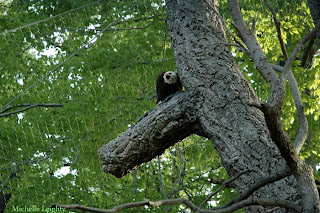


Although he and Venus seemed to be very compatible, his listing behavior became so exaggerated that he was no longer suited for public exhibit. So when we had the opportunity to obtain Orion from the Cleveland Metroparks Zoo, we grabbed at it and pulled Saturn off and put Orion on display. Saturn was then moved to the Raptor Center where his condition has worsened over the past 3 years. And thus the course of action on Saturday.

And though I would have hoped to have Saturn here far longer, 26 is a very respectable age for an eagle.

With 25 years here at CMNH, he has been a great bird, handsome, spirited, majestic and has thrilled millions of CMNH visitors. My hope is that he touched those people as he touched us and helped spread a message of respect and conservation of these noble raptors to a large and diverse audience. He will be missed.

Best,

Harvey

Friday, October 28, 2011

Snowshoe Hare Creature Feature

CMNH Wildlife Specialist Traci Lambert teaches about Lucky and Ned the Snowshoe Hares.

Thursday, October 27, 2011

Reptiles in Winter

So...it is getting close to that time of year again...winter. Humans can bundle up or stay indoors when it gets blustery but what about our native wildlife? Most of us know that mammals grow thicker coats and a larger layer of fat to keep themselves warm in the winter. Most birds insulate themselves by puffing out layers of feathers to trap air near their skin or huddle in groups with family members to stay toasty.

What about some of Ohio's reptiles? Ohio's snakes and turtles have no way of adapting their bodies to the cold temperatures they will face in the winter. Many reptiles seek shelter in holes or burrows of other animals and spend the winter dormant or inactive. Large numbers of snakes (even of different species) will share the same burrow. A reptile's system slows down during the winter months and as its metabolism decreases, its heart rate drops and it needs very little oxygen. Reptiles need very little food and water, if any, during this time.

Bodies of water are an ideal spot for many reptiles during winter. They can hide underneath rocks and logs, and even bury themselves in mud to keep warm. Painted turtles can dig up to 18 inches below a pond's bottom. They can get the oxygen they need from the water right through their skin. Terrestrial turtles, such as box turtles, dig holes in the earth to crawl into as the temperature starts to cool. They can also alter their blood composition during the winter months to keep from freezing.

To hear more about reptiles and other native Ohio wildlife and meet some in person, visit the museum for our live animal programs at 1pm and 3pm every Saturday and Sunday!


Melissa Terwilliger, CMNH Wildlife Specialist

Tuesday, October 11, 2011

Bald Eagle Creature Feature

Director of Wildlife Resources Harvey Webster discusses Bald Eagles, including Venus and Orion, the two on exhibit in the Perkins Wildlife Center: