Wildlife Specialist Kaitlyn Gabriel teaches about the Eastern Box Turtle and the Painted Turtle in this Creature Feature video:
Friday, May 4, 2012

Monday, April 30, 2012
Fish Crows in Ohio!
I wrote a short article for the Kirtland Bird Club (http://www.kirtlandbirdclub.org) about the Fish Crow nest CMNH Curator of Ornithology Dr. Andy Jones and I found last week and thought I should share it on the Wildlife Blog as well:
When I woke up on April 22nd, did I think I would be spending my day dashing back and forth across the busy intersection of Cedar and Green in University Heights with a recording device, or riding in the passenger seat of a car with my head out the window following a crow? Of course not, but it was the perfect way to spend Earth Day 2012.
The adventure began when Andy returned to our home from the grocery store with some edibles and the comment that he might have seen a Fish Crow in the parking lot. Seconds after unpacking the groceries (keeping a bag of chips for the road) and grabbing a camera, we were off! I wanted to see this possible Fish Crow while I had the chance! And maybe even help confirm its identity.
I would not call myself an expert on crows, but I do have an advantage over many people; for the past six years I have been caring for the animals in the Perkins Wildlife Center at the Cleveland Museum of Natural History, and the captive American Crows are counted amongst my favorites. And in exchange, I am counted amongst their favorite humans. That is what I assume, anyway, since every day when I enter their exhibit, within a minute I have one crow sitting on each of my shoulders and cawing in my ears. Up until the moment I was in the Heinen's parking lot scrutinizing the crow in question, I hadn't realized the full advantage of this squawking in my eardrums. But as soon as I heard our parking lot crow's vocalization, I agreed with Andy. It was not like any of the typical American Crow calls I was so used to hearing. Andy knew what Fish Crows sound like and I knew what American Crows do not sound like and our suspicion was growing.
It was time to document! After we spent several minutes running between grocery store and gas station parking lots with the recording unit and camera, our crow flew south, and the chase was on! Andy drove while I searched and soon we were tracking the bird through a Shaker Heights neighborhood. When the crow landed and we had parked the car, we were surprised to find that our possible Fish Crow had become six possible Fish Crows, with a nest to boot! We spent that afternoon observing the colony, and returned the following morning. When we felt confident with our identification, Andy hit the listservs with our photos and audio files, and crow experts agreed with the assessment. We had found the first documented Fish Crow nest in Ohio!
Michelle Leighty
Perkins Wildlife Center Co-Manager
Some photos of the Fish Crows and nest (click to enlarge):


When I woke up on April 22nd, did I think I would be spending my day dashing back and forth across the busy intersection of Cedar and Green in University Heights with a recording device, or riding in the passenger seat of a car with my head out the window following a crow? Of course not, but it was the perfect way to spend Earth Day 2012.
The adventure began when Andy returned to our home from the grocery store with some edibles and the comment that he might have seen a Fish Crow in the parking lot. Seconds after unpacking the groceries (keeping a bag of chips for the road) and grabbing a camera, we were off! I wanted to see this possible Fish Crow while I had the chance! And maybe even help confirm its identity.
I would not call myself an expert on crows, but I do have an advantage over many people; for the past six years I have been caring for the animals in the Perkins Wildlife Center at the Cleveland Museum of Natural History, and the captive American Crows are counted amongst my favorites. And in exchange, I am counted amongst their favorite humans. That is what I assume, anyway, since every day when I enter their exhibit, within a minute I have one crow sitting on each of my shoulders and cawing in my ears. Up until the moment I was in the Heinen's parking lot scrutinizing the crow in question, I hadn't realized the full advantage of this squawking in my eardrums. But as soon as I heard our parking lot crow's vocalization, I agreed with Andy. It was not like any of the typical American Crow calls I was so used to hearing. Andy knew what Fish Crows sound like and I knew what American Crows do not sound like and our suspicion was growing.
It was time to document! After we spent several minutes running between grocery store and gas station parking lots with the recording unit and camera, our crow flew south, and the chase was on! Andy drove while I searched and soon we were tracking the bird through a Shaker Heights neighborhood. When the crow landed and we had parked the car, we were surprised to find that our possible Fish Crow had become six possible Fish Crows, with a nest to boot! We spent that afternoon observing the colony, and returned the following morning. When we felt confident with our identification, Andy hit the listservs with our photos and audio files, and crow experts agreed with the assessment. We had found the first documented Fish Crow nest in Ohio!
Michelle Leighty
Perkins Wildlife Center Co-Manager
Some photos of the Fish Crows and nest (click to enlarge):


Wednesday, April 4, 2012
Turkey Vulture Creature Feature
Perkins Wildlife Center Co-Manager Michelle Leighty discusses the cool behaviors/disgusting habits of Turkey Vultures in this Creature Feature video:
Tuesday, March 6, 2012
New Kid on the Block
The Wildlife Resources department is pleased to announce it recently added a new member to its collection, an American Bullfrog named "Frogger."
Frogger was found as a tadpole by a young boy living in the Shaker Heights area in 2007. As an adult frog she became too difficult to care for so she was donated to the Nature Center at Shaker Lakes, where she lived for some time. She recently was transferred to CMNH for use in our live animal programs.
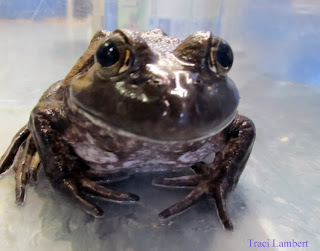
Bullfrogs lay about 20,000 eggs at a time which then hatch 4-5 days later. They stay in the tadpole stage for the entire summer, hibernate under the mud and then finish metamorphosis the following August or September. So Frogger is about 5 or 6 years old. American Bullfrogs live an average of 8 to 10 years in the wild but in captivity can live for much longer. We hope to have Frogger as part of our collection for many years to come to teach visitors about amphibians.
Bullfrogs get their name from the distinctive call the male uses to announce his presence to females and to let other males know his territory. While many describe the sound as "jug-o-rum," others think it sounds similar to a cow mooing. This is where the "bull" part of the name comes from. The vocalization can be heard up to a quarter of a mile away.
Bullfrogs can be found living in most calm freshwater bodies of water in the United States. They were native only in the eastern and central United States until they were introduced to the Pacific Northwest in the 1920's as a food source. This introduction has led to competition with other small species of frogs for territory and food.
American Bullfrogs are opportunistic hunters. They lie in wait at night for small animals to cross their paths and will jump out with mouths open to grab their meals. They will eat just about anything that fits in their mouths including insects, small reptiles, mice, and the occasional bird. Their mouths do get fairly large considering that these frogs can get up to 8 inches long and weigh around 1.5 pounds. Some bullfrogs have been known to be as heavy as 3 pounds.
While you cannot see a bullfrog this time of the year in your backyard, you can join us at Cleveland Museum of Natural History where you just might meet Frogger doing an educational program!
Traci Lambert, CMNH Wildlife Specialist
Frogger was found as a tadpole by a young boy living in the Shaker Heights area in 2007. As an adult frog she became too difficult to care for so she was donated to the Nature Center at Shaker Lakes, where she lived for some time. She recently was transferred to CMNH for use in our live animal programs.

Bullfrogs lay about 20,000 eggs at a time which then hatch 4-5 days later. They stay in the tadpole stage for the entire summer, hibernate under the mud and then finish metamorphosis the following August or September. So Frogger is about 5 or 6 years old. American Bullfrogs live an average of 8 to 10 years in the wild but in captivity can live for much longer. We hope to have Frogger as part of our collection for many years to come to teach visitors about amphibians.
Bullfrogs get their name from the distinctive call the male uses to announce his presence to females and to let other males know his territory. While many describe the sound as "jug-o-rum," others think it sounds similar to a cow mooing. This is where the "bull" part of the name comes from. The vocalization can be heard up to a quarter of a mile away.
Bullfrogs can be found living in most calm freshwater bodies of water in the United States. They were native only in the eastern and central United States until they were introduced to the Pacific Northwest in the 1920's as a food source. This introduction has led to competition with other small species of frogs for territory and food.
American Bullfrogs are opportunistic hunters. They lie in wait at night for small animals to cross their paths and will jump out with mouths open to grab their meals. They will eat just about anything that fits in their mouths including insects, small reptiles, mice, and the occasional bird. Their mouths do get fairly large considering that these frogs can get up to 8 inches long and weigh around 1.5 pounds. Some bullfrogs have been known to be as heavy as 3 pounds.
While you cannot see a bullfrog this time of the year in your backyard, you can join us at Cleveland Museum of Natural History where you just might meet Frogger doing an educational program!
Traci Lambert, CMNH Wildlife Specialist
Tuesday, February 14, 2012
Valentine's Day in the Animal Kingdom
Today is Valentine's Day, a time for us humans to express our love for one another. Although animals don't give boxes of chocolates with pretty ribbons, they do have some interesting rituals to impress potential mates.
The Bald Eagle is famous for being the national symbol of the United States. Avid bird watchers, however, know them for their amazing Cartwheel Display. In this aerial ritual, a pair flies to great heights and then locks talons as they do “cartwheels” plummeting down towards the ground. They only break apart at the very last moment.
Eastern Screech Owl males approach females while vocalizing, bobbing their heads, and winking their eyes slowly. If a female accepts his advances, she will put her bill next to his and they will preen each other.
The males of many bird species bring food to the females. A male Northern Cardinal will offer seeds to its mate, placing the seed in the female's bill. Male American Kestrels will bring food to a perch and announce the offering with a call and a fluttering flight. The female perches next to the male and they each bow their heads several times before the female takes the mouse or large insect from the talons of her mate.
A male Eastern Box Turtle chases his intended mate and nips at her shell or chin.
In possibly the most fascinating mating display, Snowshoe Hare males jump and urinate on the females from midair! The female sometimes does the same to the male.
To learn more about the interesting rituals of Ohio’s wildlife, come visit Perkins Wildlife Center and catch one of our live animal programs every Saturday and Sunday at 1 PM and 3 PM.
Kaitlyn Gabriel, CMNH Wildlife Specialist
The Bald Eagle is famous for being the national symbol of the United States. Avid bird watchers, however, know them for their amazing Cartwheel Display. In this aerial ritual, a pair flies to great heights and then locks talons as they do “cartwheels” plummeting down towards the ground. They only break apart at the very last moment.
Eastern Screech Owl males approach females while vocalizing, bobbing their heads, and winking their eyes slowly. If a female accepts his advances, she will put her bill next to his and they will preen each other.
The males of many bird species bring food to the females. A male Northern Cardinal will offer seeds to its mate, placing the seed in the female's bill. Male American Kestrels will bring food to a perch and announce the offering with a call and a fluttering flight. The female perches next to the male and they each bow their heads several times before the female takes the mouse or large insect from the talons of her mate.
A male Eastern Box Turtle chases his intended mate and nips at her shell or chin.
In possibly the most fascinating mating display, Snowshoe Hare males jump and urinate on the females from midair! The female sometimes does the same to the male.
To learn more about the interesting rituals of Ohio’s wildlife, come visit Perkins Wildlife Center and catch one of our live animal programs every Saturday and Sunday at 1 PM and 3 PM.
Kaitlyn Gabriel, CMNH Wildlife Specialist
Sunday, January 29, 2012
Groundhog Fun Day News Report
Groundhog Fun Day was a huge success! WKYC Channel 3 covered the event. The video of the footage, featuring Director of Wildlife Resources Harvey Webster, Perkins Wildlife Center Co-Manager Michelle Leighty, and Lake Erie Eddie the Groundhog, can be seen below.
Saturday, January 21, 2012
Groundhog Fun Day 2012!
Groundhog Fun Day 2012 is just one week away! Join the Wildlife staff and Eddie the Whistle Pig in celebrating on Saturday, January 28th!
Subscribe to:
Posts (Atom)