Sunday, October 21, 2012

Spiders!

They’re creepy, they’re crawly, they have eight legs and they send people running whenever they enter a room. No, they’re not Pittsburgh Steelers fans. They’re spiders. Did you know there are over 50,000 species of spiders in the world, and more are being discovered every day! They are awesome animals that play a very important role in our environment. What do you say we play a CMNH style game of Myth Busters all about spiders?

Myth #1. Every spider is venomous and can hurt us.
True and False - While every spider is venomous only a very small percentage of spiders are dangerous to humans, and of our over 500 different spiders found in Ohio only 2 can be harmful to humans and those are rare species and easily identifiable if you take the time to look before you squash. They are the black widow and the brown recluse.

Myth #2. Spiders are insects.
False - Spiders are not insects. Insects belong to a totally different class of animals and there are some easy ways to tell them apart. Insects have 3 main body parts: the head, the thorax and the abdomen. Spiders have 2 body parts: they have the abdomen like insects but they have combined their head and thorax to form the cephalothorax. Spiders have 8 legs and insects have 6. Insects have antennae and spiders do not.

Myth #3. Spider silk is stronger than steel.
True - Spiders can produce many types of silk, some used for webs, some for non-sticky support lines, some for trap door webs, and even some webs used for parachutes that allow them to float on the wind, and each species can specialize on making different types of silk. Studies have shown that certain types of spider silk, especially silk from the orb spider family can be comparable and even stronger then steel at the same diameter.

Myth #4. Spiders are dangerous to humans because they are dirty and pass on disease.
False - In fact, spiders play an important role in keeping infectious disease cases down in human populations around the world. Spiders are among the most prolific predators of mosquitoes and flies. These are two of the biggest vectors for animal to human related diseases in the world. The more spiders we have the less mosquitoes and flies we have which means we have a better chance of keeping infectious diseases like malaria and West Nile from spreading through our human populations.

If you would like to satisfy your curiosity for arachnids stop down at the Cleveland Museum of Natural History. You never know when our very own Chilean rose tarantula Anansi will make a guest appearance at one of our live animal shows. Get an up close look at all the cool features that make spiders spiders. Maybe after meeting Anansi you will think twice the next time you see a spider and instead of smashing it remember, they are more helpful to us alive and catching insects than they are at the bottom of your shoe.

Joe Dell'Anno
Perkins Wildlife Center Co-Manger

Saturday, October 13, 2012

Skunks: Will Work For Food

Willow and Lilac have lived at the museum since July of 2011. Born in captivity, they have turned into fantastic program animals for the Cleveland Museum of Natural History. Both the wildlife staff and the education staff use the skunks regularly in classes.

Training the skunks to go in and out of a kennel for travel to class has been unusually challenging. Many of our animals are frightened of their kennels and need to be rewarded for going into them. The skunks, on the other hand, love their kennels! The problem is getting them out when it is time for class to start. Training them to come out has been a multi-step process. The first step was rewarding them when they just poked their head out of the kennel. When they mastered that, they got rewarded for putting one foot out of the kennel, then two feet, three feet, four feet, and finally for coming all the way out. During this process, whenever the skunks got rewarded, they would take their treat and rush right back into the kennel. So the final step was rewarding the girls when they would come out and stay out while we either picked them up or closed the door behind them.

Each girl has her own personality and training them required attention be paid to their individuality. Willow is farther along in her training. She will come out and stay out long enough to be picked up, without closing the door behind her. Lilac is more nervous and the door must still be closed behind her or else she will dart back into the kennel before you can pick her up. With staff attention and the right treats, Lilac will be coming out of her kennel perfectly in no time. What is the perfect treat to train a skunk? Willow loves raisins while Lilac prefers worms.

Kaitlyn Gabriel, Wildlife Specialist

Tuesday, October 9, 2012

Meet our new female Red Fox!

Look who arrived yesterday!


This young female Red Fox was born in the spring of this year. She was orphaned and raised at a rehab center in northwest Ohio. Weighing in at just under 9 pounds, she has not yet reached her adult size. She is out on exhibit in the Perkins Wildlife Center and is adjusting well to her new home. She is a little on the shy side but her playful nature has already made its appearance. The staff is thrilled to have her and has begun working on her socialization.

We named her "Scarlet."

Stay tuned for more updates!

Michelle Leighty
Perkins Wildlife Center Co-Manager

Friday, September 21, 2012

Meet Beaker at Owls and Howls!

Owls & Howls is Saturday, October 20th! Wildlife Specialist Nikki McClellan gives more info on the event and introduces Beaker the Barred Owl in this video:

Thursday, August 2, 2012

Charcoal the Coyote!


The Wildlife department's new baby coyote arrived late yesterday afternoon!

She was injured and orphaned as a young pup during a controlled burn in Michigan. The fire killed the rest of the little coyote's family and left her with some minor burns and scars. She was hand-raised by a rehabber in Michigan.

She is about 3 or 4 months old and since she has spent nearly her entire life in captivity around people, she cannot be released back into the wild. Her new home is the Cleveland Museum of Natural History. She lives in a roomy exhibit in the Perkins Wildlife Center and will be trained by wildlife staff members for use in programs.


The wildlife staff has spent the past day getting to know her and socializing her. We will be harness training her so that she can go on long walks around the wildlife center and also go to classes. She will serve as an animal ambassador for her species and educate the public about coyotes.


So far she is adapting well to her new surroundings and has been playful and engaged with the wildlife specialists caring for her.


Her name is "Charcoal," which I suggested due to her gray color and the circumstances which brought her into captivity.

We call her "Char" for short.


Michelle Leighty
Perkins Wildlife Center Co-Manager

Wednesday, July 18, 2012

You CAN Teach an Old Dog… errr Turkey… New Tricks!

If you’ve ever visited the Ralph Perkins Wildlife Center you’ve probably seen one of our iconic animals front and center – Big Jake the Wild Turkey. Jake came to us in August of 2002 when he was about one year of age. He had been found in Findlay, Ohio where he appeared to be very tame due to people hand feeding him. People mean well when they feed wild animals, but it is actually not the best thing for the animal. They can become too dependent on people to feed them and not be able or willing to find food on their own. It can also make them too complacent with people and thus leave them being sitting ducks for hunters. For these reasons Jake could not safely remain in the wild and needed a place to live and we were more than happy to provide that for him.

Since coming here, Jake has been very visible to all of our visitors as a resident of our deer yard. He is generally found strutting along the fence line, very brightly colored, and even occasionally gobbling. Most people think he is being friendly, but that is actually him showing off his aggressive side. If given the chance he would happily kick the people on the other side of the fence and show them who he thinks is boss. For those reasons when a new wildlife specialist begins his or her career in the Perkins Wildlife Center the first thing he or she must do is chase that turkey! We aren’t doing that to be mean, but we have to prove our dominance over him or else he will prove his dominance over us. For these reasons Jake is not the easiest animal at the museum to train. Oddly enough though, for as aggressive as he is, he is actually very afraid of new objects and situations… like kennels.

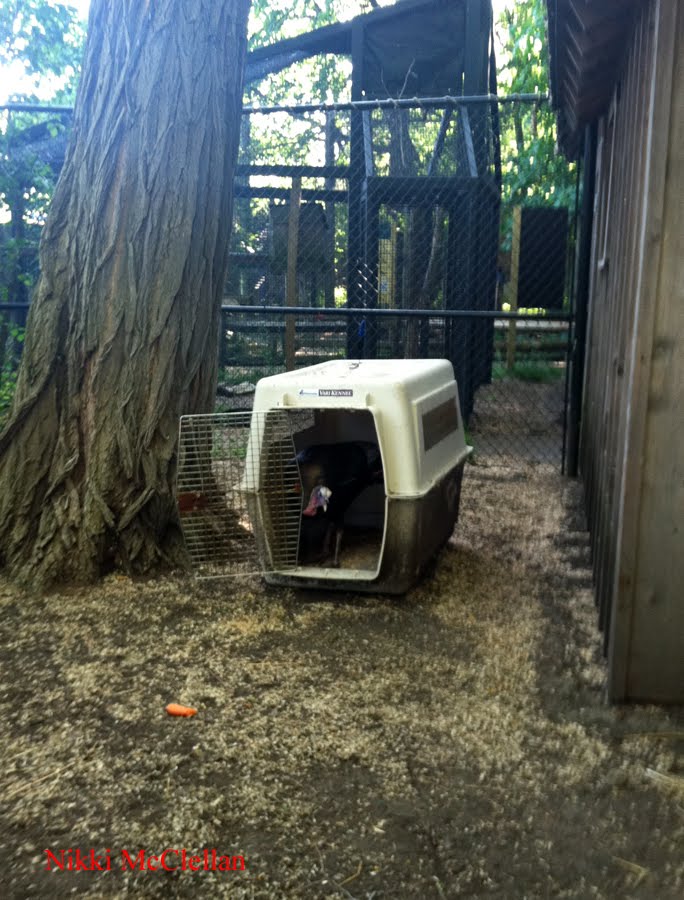
This year I was looking for a challenge, and after a health scare last year with Jake (he’s fine now, don’t worry!) we felt it was time he became kennel trained so that he could easily be transported to the veterinarian for examination. However, since he was already 11 years old and pretty much terrified of his kennel I was a little unsure of how things would go. Training is definitely a step by step process and the first thing I had to do was get Jake used to seeing this new, big, scary thing in his yard. So I first had to just put the kennel in his yard and get him used to eating in front of it. He gets fed in both the morning and the evening and since his evening food is used to put him in his overnight area I had to use his morning diet for training purposes. His morning diet is also not his favorite seeing as it is just scratch (dried corn and seeds) so I added a few peanuts to sweeten the deal. He started eating in front of the kennel pretty readily, but when it was time to move to the next step of eating in the kennel he was very reluctant. I had been trying to hand him the peanuts through the bars on the side of the kennel and he wanted nothing to do with sticking his head in there for them.

At that point I realized I had to take a step back and get Jake used to eating out of my hand. Before this point we had always just put Jake’s food on the ground and let him eat while we fed the deer. Jake pretty readily ate the peanuts out of my hand away from the kennel, but we had to inch our way closer and closer to the kennel. Finally one day we walked our way over the kennel and he took some peanuts through the bars! This may not seem like a big deal, but for Jake this was huge! He had to stick his head and neck all the way in to reach the peanut in the kennel, but not his legs… that would come later. From that point though it was just a matter of working with him every day that I was at the museum until he trusted me enough to go all of the way in the kennel and turn around in it. We are now at the point where I can shut the door half way while he is facing forward in the kennel… we are almost there! Once I can have him go in the kennel, turn around, and let me shut the door he will be considered kennel trained. So it may have taken a few months, but we are in the home stretch and now if Jake ever gets sick again he will be able to easily be transported to our veterinarian. I wasn’t sure Jake would ever be able to be trained, but I guess you can teach an old turkey new tricks!

Nikki McClellan
Wildlife Specialist

Wednesday, July 4, 2012

Happy Independence Day!

George the Bald Eagle kept cool this morning by taking a bath! Happy Fourth of July!