Thursday, August 2, 2012
Charcoal the Coyote!
The Wildlife department's new baby coyote arrived late yesterday afternoon!
She was injured and orphaned as a young pup during a controlled burn in Michigan. The fire killed the rest of the little coyote's family and left her with some minor burns and scars. She was hand-raised by a rehabber in Michigan.
She is about 3 or 4 months old and since she has spent nearly her entire life in captivity around people, she cannot be released back into the wild. Her new home is the Cleveland Museum of Natural History. She lives in a roomy exhibit in the Perkins Wildlife Center and will be trained by wildlife staff members for use in programs.
The wildlife staff has spent the past day getting to know her and socializing her. We will be harness training her so that she can go on long walks around the wildlife center and also go to classes. She will serve as an animal ambassador for her species and educate the public about coyotes.
So far she is adapting well to her new surroundings and has been playful and engaged with the wildlife specialists caring for her.
Her name is "Charcoal," which I suggested due to her gray color and the circumstances which brought her into captivity.
We call her "Char" for short.
Michelle Leighty
Perkins Wildlife Center Co-Manager
Wednesday, July 18, 2012
You CAN Teach an Old Dog… errr Turkey… New Tricks!
If you’ve ever visited the Ralph Perkins Wildlife Center you’ve probably seen one of our iconic animals front and center – Big Jake the Wild Turkey. Jake came to us in August of 2002 when he was about one year of age. He had been found in Findlay, Ohio where he appeared to be very tame due to people hand feeding him. People mean well when they feed wild animals, but it is actually not the best thing for the animal. They can become too dependent on people to feed them and not be able or willing to find food on their own. It can also make them too complacent with people and thus leave them being sitting ducks for hunters. For these reasons Jake could not safely remain in the wild and needed a place to live and we were more than happy to provide that for him.
Since coming here, Jake has been very visible to all of our visitors as a resident of our deer yard. He is generally found strutting along the fence line, very brightly colored, and even occasionally gobbling. Most people think he is being friendly, but that is actually him showing off his aggressive side. If given the chance he would happily kick the people on the other side of the fence and show them who he thinks is boss. For those reasons when a new wildlife specialist begins his or her career in the Perkins Wildlife Center the first thing he or she must do is chase that turkey! We aren’t doing that to be mean, but we have to prove our dominance over him or else he will prove his dominance over us. For these reasons Jake is not the easiest animal at the museum to train. Oddly enough though, for as aggressive as he is, he is actually very afraid of new objects and situations… like kennels.
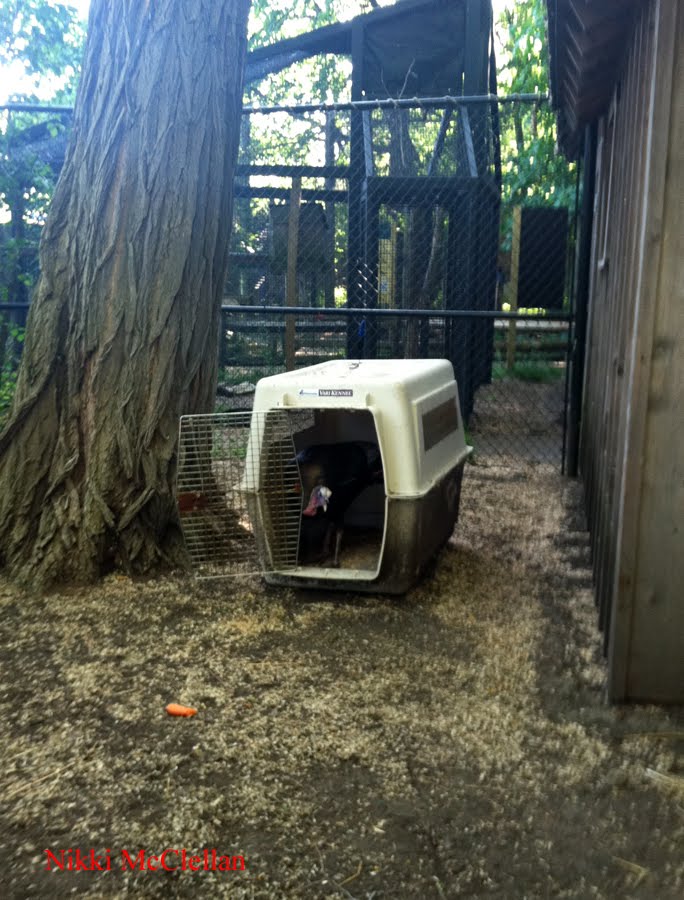
This year I was looking for a challenge, and after a health scare last year with Jake (he’s fine now, don’t worry!) we felt it was time he became kennel trained so that he could easily be transported to the veterinarian for examination. However, since he was already 11 years old and pretty much terrified of his kennel I was a little unsure of how things would go. Training is definitely a step by step process and the first thing I had to do was get Jake used to seeing this new, big, scary thing in his yard. So I first had to just put the kennel in his yard and get him used to eating in front of it. He gets fed in both the morning and the evening and since his evening food is used to put him in his overnight area I had to use his morning diet for training purposes. His morning diet is also not his favorite seeing as it is just scratch (dried corn and seeds) so I added a few peanuts to sweeten the deal. He started eating in front of the kennel pretty readily, but when it was time to move to the next step of eating in the kennel he was very reluctant. I had been trying to hand him the peanuts through the bars on the side of the kennel and he wanted nothing to do with sticking his head in there for them.
At that point I realized I had to take a step back and get Jake used to eating out of my hand. Before this point we had always just put Jake’s food on the ground and let him eat while we fed the deer. Jake pretty readily ate the peanuts out of my hand away from the kennel, but we had to inch our way closer and closer to the kennel. Finally one day we walked our way over the kennel and he took some peanuts through the bars! This may not seem like a big deal, but for Jake this was huge! He had to stick his head and neck all the way in to reach the peanut in the kennel, but not his legs… that would come later. From that point though it was just a matter of working with him every day that I was at the museum until he trusted me enough to go all of the way in the kennel and turn around in it. We are now at the point where I can shut the door half way while he is facing forward in the kennel… we are almost there! Once I can have him go in the kennel, turn around, and let me shut the door he will be considered kennel trained. So it may have taken a few months, but we are in the home stretch and now if Jake ever gets sick again he will be able to easily be transported to our veterinarian. I wasn’t sure Jake would ever be able to be trained, but I guess you can teach an old turkey new tricks!
Nikki McClellan
Wildlife Specialist
Since coming here, Jake has been very visible to all of our visitors as a resident of our deer yard. He is generally found strutting along the fence line, very brightly colored, and even occasionally gobbling. Most people think he is being friendly, but that is actually him showing off his aggressive side. If given the chance he would happily kick the people on the other side of the fence and show them who he thinks is boss. For those reasons when a new wildlife specialist begins his or her career in the Perkins Wildlife Center the first thing he or she must do is chase that turkey! We aren’t doing that to be mean, but we have to prove our dominance over him or else he will prove his dominance over us. For these reasons Jake is not the easiest animal at the museum to train. Oddly enough though, for as aggressive as he is, he is actually very afraid of new objects and situations… like kennels.
This year I was looking for a challenge, and after a health scare last year with Jake (he’s fine now, don’t worry!) we felt it was time he became kennel trained so that he could easily be transported to the veterinarian for examination. However, since he was already 11 years old and pretty much terrified of his kennel I was a little unsure of how things would go. Training is definitely a step by step process and the first thing I had to do was get Jake used to seeing this new, big, scary thing in his yard. So I first had to just put the kennel in his yard and get him used to eating in front of it. He gets fed in both the morning and the evening and since his evening food is used to put him in his overnight area I had to use his morning diet for training purposes. His morning diet is also not his favorite seeing as it is just scratch (dried corn and seeds) so I added a few peanuts to sweeten the deal. He started eating in front of the kennel pretty readily, but when it was time to move to the next step of eating in the kennel he was very reluctant. I had been trying to hand him the peanuts through the bars on the side of the kennel and he wanted nothing to do with sticking his head in there for them.
At that point I realized I had to take a step back and get Jake used to eating out of my hand. Before this point we had always just put Jake’s food on the ground and let him eat while we fed the deer. Jake pretty readily ate the peanuts out of my hand away from the kennel, but we had to inch our way closer and closer to the kennel. Finally one day we walked our way over the kennel and he took some peanuts through the bars! This may not seem like a big deal, but for Jake this was huge! He had to stick his head and neck all the way in to reach the peanut in the kennel, but not his legs… that would come later. From that point though it was just a matter of working with him every day that I was at the museum until he trusted me enough to go all of the way in the kennel and turn around in it. We are now at the point where I can shut the door half way while he is facing forward in the kennel… we are almost there! Once I can have him go in the kennel, turn around, and let me shut the door he will be considered kennel trained. So it may have taken a few months, but we are in the home stretch and now if Jake ever gets sick again he will be able to easily be transported to our veterinarian. I wasn’t sure Jake would ever be able to be trained, but I guess you can teach an old turkey new tricks!
Nikki McClellan
Wildlife Specialist
Wednesday, July 4, 2012
Monday, July 2, 2012
Training: Enriching the Lives of Animals and Their Keepers
Here at the Perkins Wildlife Center, there is a lot more to taking care of our animals than just feeding them and cleaning their cages. Training with the animals is one of the most important parts of our day.
We never train our animals to do “tricks”. The behaviors that we train our animals to do either mimic natural behaviors, allow us to give them medical care, or keep both animals and keepers from harm’s way. Continuously teaching new behaviors and practicing the already learned behaviors help to keep an animal’s body and mind physically and mentally healthy.
Many of our animals are kennel trained, which allows us to easily transport them to the vet without handling them. Our larger mammals are also station trained. This means that they know to wait at a certain station or area when the keepers enter the enclosure. This not only keeps us a safe distance from the animals, it also helps deter food aggression between animals sharing the same exhibit.
“Target” training is another behavior learned by many of our animals. By “targeting” to a ball on a pole, an animal can be moved from location to location within their enclosure. This is important because if anything harmful ever gets thrown into one of the exhibits or something dangerous is discovered inside (ex: bee hive), an animal can be moved out of the area quickly and easily.
Teaching our animals different behaviors also strengthens their relationships with us, the keepers.
Melissa Terwilliger, Wildlife Specialist and Training Coordinator
We never train our animals to do “tricks”. The behaviors that we train our animals to do either mimic natural behaviors, allow us to give them medical care, or keep both animals and keepers from harm’s way. Continuously teaching new behaviors and practicing the already learned behaviors help to keep an animal’s body and mind physically and mentally healthy.
Many of our animals are kennel trained, which allows us to easily transport them to the vet without handling them. Our larger mammals are also station trained. This means that they know to wait at a certain station or area when the keepers enter the enclosure. This not only keeps us a safe distance from the animals, it also helps deter food aggression between animals sharing the same exhibit.
“Target” training is another behavior learned by many of our animals. By “targeting” to a ball on a pole, an animal can be moved from location to location within their enclosure. This is important because if anything harmful ever gets thrown into one of the exhibits or something dangerous is discovered inside (ex: bee hive), an animal can be moved out of the area quickly and easily.
Teaching our animals different behaviors also strengthens their relationships with us, the keepers.
Melissa Terwilliger, Wildlife Specialist and Training Coordinator
Friday, June 1, 2012
Bird Vet Visit
In order to keep the museum's animals as healthy as possible, we make sure they see a veterinarian at least once a year for a full check-up. While the Perkins Wildlife staff is trained to identify and treat many injuries and illnesses, it is unable to look inside of an animal to see how well its body is functioning. We have several collaborating veterinarians, each specializing in different kinds of animals. This spring, Dr. Lindstrom of Animal Clinic Northview came to CMNH to take blood from our birds and to deliver their annual West Nile vaccinations. The wildlife staff is trained to catch and restrain the birds in a safe manner for the exams. Since we cannot explain to the birds what we are doing, it can be a stressful experience for them. In some cases, a hood is placed on the bird’s head to impair its vision and reduce stress. George, a Bald Eagle, wears a hood whenever he needs to be grabbed for vet visits or coping (trimming of the beak and nails). In addition, some birds get a shot of vitamins to reduce the risk of capture myopathy, a potentially deadly syndrome that can occur after the restraint of wild animals.
Melissa Terwilliger is pictured below restraining George for his examination:
West Nile has had a strong impact on American birds since it arrived in New York City in 1999. It is spread through the bite of a mosquito and has been detected in 250 avian species. Some have been devastated by the virus. American Crows, for example, experienced a 45 percent decline throughout the nation. North American raptors (birds of prey) are very sensitive to the virus, especially those living near swamps and rivers. Some of our birds came to the Cleveland Museum of Natural History from rehab centers and still exhibit lasting effects of West Nile virus. Venus, our female Bald Eagle, recovered from the virus but now grows defective flight feathers. Arwen the Red-tailed Hawk and Big Mama the Great Horned Owl both have neurological issues caused by West Nile. Getting this vaccine will protect our birds from this potentially deadly virus.
In addition to vaccinating and examining them physically, our veterinarian draws blood from the birds so we can get a full picture of their health. This spring all of our blood results came back healthy, except for our Eastern Screech-Owl, Easo. The results indicated that Easo’s liver is not functioning properly. With this knowledge, the wildlife staff was able to prescribe an appropriate daily dosage of liver medications. Our collaborating veterinarians are a major factor in the health and well-being of our resident animals and their time and effort is much appreciated by the Perkins Wildlife Center staff.
Kaitlyn Gabriel
CMNH Wildlife Specialist
Melissa Terwilliger is pictured below restraining George for his examination:
West Nile has had a strong impact on American birds since it arrived in New York City in 1999. It is spread through the bite of a mosquito and has been detected in 250 avian species. Some have been devastated by the virus. American Crows, for example, experienced a 45 percent decline throughout the nation. North American raptors (birds of prey) are very sensitive to the virus, especially those living near swamps and rivers. Some of our birds came to the Cleveland Museum of Natural History from rehab centers and still exhibit lasting effects of West Nile virus. Venus, our female Bald Eagle, recovered from the virus but now grows defective flight feathers. Arwen the Red-tailed Hawk and Big Mama the Great Horned Owl both have neurological issues caused by West Nile. Getting this vaccine will protect our birds from this potentially deadly virus.
In addition to vaccinating and examining them physically, our veterinarian draws blood from the birds so we can get a full picture of their health. This spring all of our blood results came back healthy, except for our Eastern Screech-Owl, Easo. The results indicated that Easo’s liver is not functioning properly. With this knowledge, the wildlife staff was able to prescribe an appropriate daily dosage of liver medications. Our collaborating veterinarians are a major factor in the health and well-being of our resident animals and their time and effort is much appreciated by the Perkins Wildlife Center staff.
Kaitlyn Gabriel
CMNH Wildlife Specialist
Monday, May 7, 2012
Peregrine Falcon Chick Banding 2012!
This morning was the banding ceremony at the Terminal Tower Peregrine Falcon nest site! Only one chick hatched this year and it was determined to be a female. She is not named at this point but suggestions were given to Ohio Division of Wildlife staff and the choice will be released at a later date.
The chick was found to be in good health, free of parasites, and on the plump side. Being an only child has advantages. Namely, all of the food and parental attention!
Mother falcon SW continues to run a successful nest. One can observe the scrape online via the FalconCam.
http://www.falconcam-cmnh.org
Michelle Leighty
CMNH Perkins Wildlife Center Co-Manager
Friday, May 4, 2012
Turtles!
Wildlife Specialist Kaitlyn Gabriel teaches about the Eastern Box Turtle and the Painted Turtle in this Creature Feature video:
Subscribe to:
Posts (Atom)