Monday, October 21, 2013
A Very Hoppy Welcome to Our New Snowshoe Hares!
Last week we welcomed three new snowshoe hares to the Perkins Wildlife Center. They were born in captivity just two months ago and were in need of a place to live. Many times when a wild animal is raised in captivity it becomes too friendly or too used to people. Since these animals were raised by humans and never learned how to be “wild” hares they were not able to be released. The museum is now their permanent home and we are very happy to have them. Snowshoe hares are interesting animals that allow us to educate our visitors on what most think are “just rabbits.” Although they belong to the same family, snowshoe hares are quite different. For example, rabbits are altricial, born helpless, hairless and blind. Hares are what are called precocial and they are born ready to go, with both vision and fur. Soon after a hare is born it is ready to live on its own. Both are herbivores but rabbits tend to eat softer plant matter such as grasses and stems, whereas hares prefer to eater harder plant matter like bark, twigs and buds.
Snowshoe hares are one of Ohio’s endangered mammal species and their decreasing populations are becoming even more of a concern with climate change. The fur of a snowshoe hare changes from brown in the spring to white in the winter. This camouflage, along with their “snowshoe” like feet to help them stay above the snow when they hop, is essential in keeping them safe from predators. This change in fur color occurs not based on temperature changes but on the amount of light in the day. As the days get shorter in the winter and there is less daylight, it triggers a hare's coat to start changing white. A snowshoe hare's coat will change color seasonally regardless of what the weather is doing. If snowfall starts later and/or melts earlier in the season there are fewer places for the hares to hide. A white hare against a green and brown background makes it easy prey. The hare might think that it is camouflaged, but it is not, making it much more vulnerable to predators. Although snowshoe hares are rarely seen in Ohio they are very common throughout the northern forests of North America and also in Canada.
Hurry to the museum and visit the hares as their coats begin to change to winter white. You can learn lots more about snowshoe hares and other native Ohio wildlife at the Perkins Wildlife Center and Woods Garden!
Melissa Terwilliger
CMNH Wildlife Specialist
Saturday, August 10, 2013
Kirtlandia Research Intern 2013
Cara Anderson spent the summer in the Wildlife Resources department researching the intelligence and problem solving capabilities of American Crows, using our resident crows Rook and Roxy as her subjects. On August 10 she presented her findings to the Kirtlandia Society and also participated in a poster session.
The Kirtlandia Research Interns spend 8 weeks during the summer conducting research projects at the museum, working with curators and other staff. To learn more about the program and how to apply visit this link:
http://www.cmnh.org/site/AboutUs/CareerOpportunities/AdoptAStudent.aspx
Thanks for all of your hard work, Cara!
Friday, July 26, 2013
More than Just a “Saber-toothed Sausage”
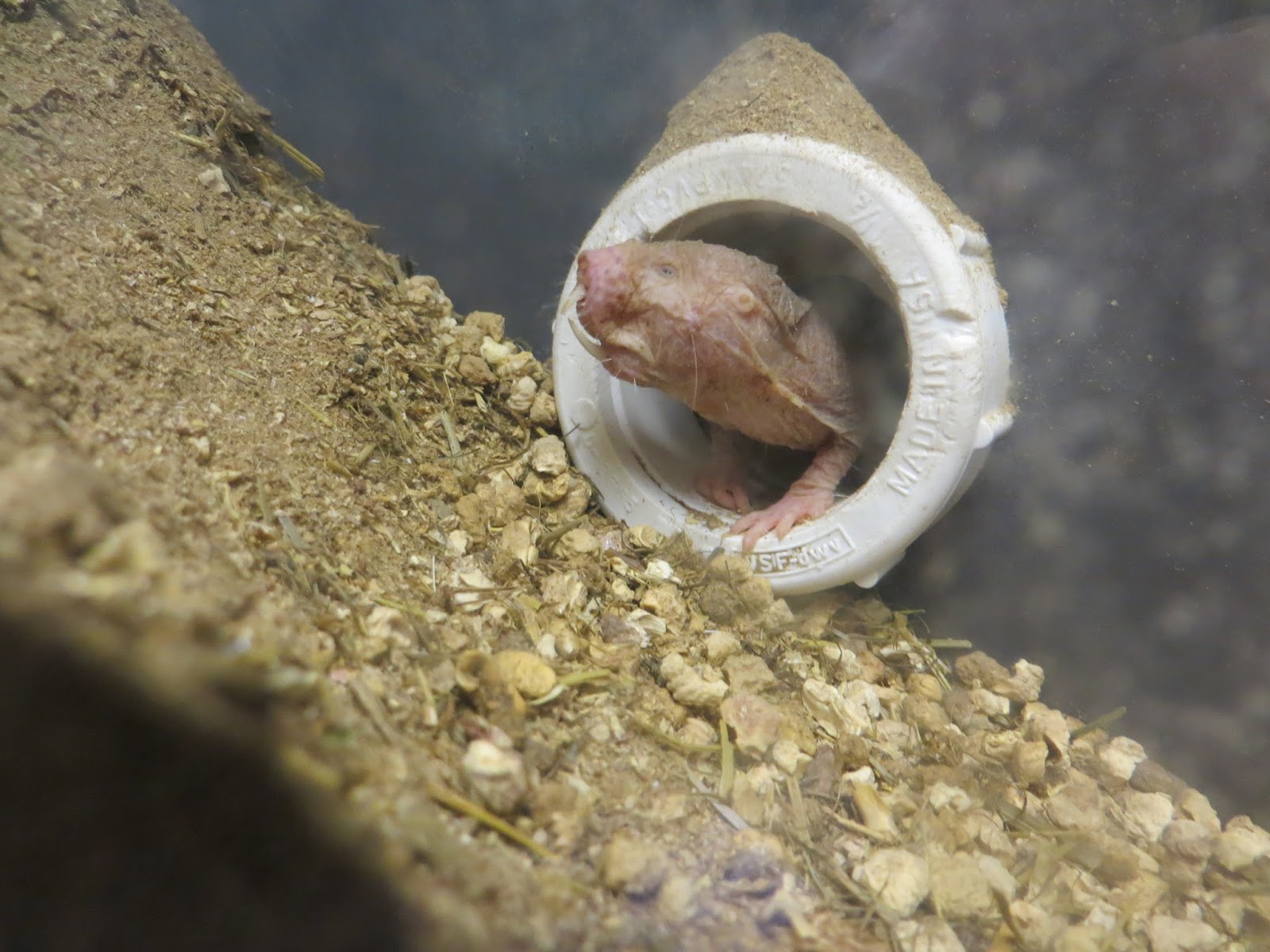
Eww!...Cool!...Wow! Just some of the things you might say when you see the museum's naked mole rat collection. Our naked mole rat colony arrived at the museum in 2010 to be displayed with the traveling exhibit “Extreme Mammals.” Right now they are housed behind the scenes but will soon be back on exhibit within the museum.
Although they look naked, these mole rats actually have tiny hairs all over their bodies that act like whiskers and help them get around. They don’t need lots of thick fur because they spend their lives entirely underground in their native region of East Africa. They build underground communities, much like that of some insects, and are one of two mammal species that are eusocial. This means that each mole rat colony has one designated “queen” that “rules the roost” so to speak. She will breed with a few males of the colony while the non-breeding individuals of the colony help to take care of the young and provide for (workers) and protect (soldiers) the rest of the group. Our mole rat colony here at the Cleveland Museum of Natural History currently has 37 individuals. The queen can have young between four and five times a year and have up to 27 young at a time. With ample space and food resources, a colony can contain up to 300 individuals !!!
Naked mole rats use their sharp incisors and flexible bodies to dig their extensive tunnel systems, find food (roots and tubers) and fend off predators (their main predator being snakes that enter their burrows). They work together to survive and count on each other to keep warm when the temperature drops. The mole rats do not have the ability to regulate their own body temperature and therefore need to make their homes in underground areas where the temperature remains mostly constant. But what about the low oxygen supply underground? No problem for naked mole rats. These little guys do need oxygen to survive but have highly adapted respiratory and cardiovascular systems that allow them to survive in these low oxygen environments. How amazing! And I haven’t even touched on one of the most amazing facts about these little rodents! They are immune to cancer and can live up to 30 years! This is far longer than other rodents. Scientists from around the world are highly intrigued and are doing extensive research to determine what it is that keeps naked mole rats cancer free. Many discoveries have been made as experiments continue and researchers hope to one day use these findings to develop a cure for human cancer.
Be sure to look for our naked mole rat collection within upcoming exhibits!
Melissa Terwilliger
Wildlife Specialist
Tuesday, July 2, 2013
Lancelot
All hail Sir Lancelot! Welcome to the newest member of the Perkins Wildlife Family!
On May 10th, the Perkins Wildlife Center welcomed its newest member: a 10-day-old porcupine who has since been dubbed Lancelot! He came to us from Pennsylvania and at the time weighed only 400 grams and was still drinking formula. Our wildlife specialists took turns taking him home every night so that we could continue his around-the-clock feedings since just like a human baby he needed to eat every 3 to 4 hours. He is now a healthy, growing 2-month-old who weighs about 1100 grams and eats a steady diet of fruits, vegetables, and rodent blocks. Once full grown, at about a year of age, he will weigh anywhere between 30 and 40 pounds! He has settled into life here in the Perkins Wildlife Center quite nicely and we are very happy to have him!
Why a porcupine at the Cleveland Museum of Natural History you may ask? As most know, we care for a collection of over 80 native Ohio animals, but many don’t know that porcupines were also once found in Ohio. They had a vast range over much of the northeastern United States, but were extirpated from Ohio due to deforestation in the 1800's. They have remained common in the expansive forests of nearby Pennsylvania. It is theorized that there might be porcupines in Ashtabula and Trumbull counties. We are very excited to welcome Lancelot to our collection as an animal ambassador who will be able to go to educational programs and meet and greet the public to help educate them about porcupines. For example, many people are under the misconception that porcupines can shoot out their quills as a means of defense against predators. This is not exactly how a porcupine defends itself. They do have quills that become barbs when stuck in a predator, but they cannot shoot them out. What a porcupine will do, however, is smack a predator with his tail where the majority of his quills are and thus the predator will end up with the quills embedded in his body. And a porcupine doesn't only have quills on his tail. They actually have them all over their body except on their stomachs.
To learn more about these fascinating creatures (They can swim! Their hollow quills make them very buoyant!) come visit us for one of our live animal shows and you may just get lucky enough to meet our newest member! Our shows are at 1:00 pm and 3:00 pm on Saturdays and Sundays and at 1:30 pm every week day through Labor Day.
Nikki McClellan
Wildlife Specialist/Enrichment Coordinator
Wednesday, June 19, 2013
Painting Bobcat!
Here at the museum the wildlife staff does a variety of different training and enrichment activities to keep our animals active and mentally stimulated. Enrichment can be an object, scent, or new environment that stimulates and excites the animal. In the past we have done paintings with our snakes and groundhog, which stimulates their senses of touch and sight. Recently we found out we have another artist in our wildlife department, an 11-year-old bobcat named Bob!
We incorporated training that Bob already knew in order for him to create the painting. We train many of our animals behaviors that make it easier and safer for the keepers to interact with them and also that keep them mentally and physically fit. "Target" is a trained behavior that many of our animals know. It involves an animal touching a ball that is on the end of a stick with their snout or paws. This allows us to direct where we want our animals to go in the exhibit. When we hold out the target pole and give the command, the animal comes over and, in Bob’s case, places both front paws on the target ball. Since Bob had never seen or touched canvas or paint before, it was a great enrichment for him and reinforced his training in a completely different way than had been done before.
Bob targeting:
Targeting Bob to the canvas and paint:
Heather Bowman
CMNH Wildlife Specialist
Saturday, June 8, 2013
Parade the Circle
The museum's animal ambassadors had quite a presence at this year's Parade the Circle! Here is a snap of Wildlife Resources volunteer Peter Pesch and Beaker the Barred Owl near the parade route in front of CMNH.
photo by Michelle Leighty
Tuesday, May 28, 2013
Look Who's Here!
More on our baby North American porcupine Lancelot coming soon!
photo by Michelle Leighty, Perkins Wildlife Center Manager
Subscribe to:
Posts (Atom)